Showing posts with label Dublin. Show all posts

Sunday, June 24, 2012

BLOOMSDAY: Alfonso Zapico


Dublinés, by © Alfonso Zapico
I am mostly a reader of novels. However, for my birthday, my sister gave me a big book called Dublinés (“Dubliner”). The author is Alfonso Zapico, and his book is a graphic novel based on James Joyce's biography. If I remember correctly, that is the first graphic novel I have read; well, I am not even sure if that is the correct description for that kind of work. In any case, I treasure my days reading in the sun (in the dark, in the sun, there are moments for everything *wink-wink*) smiling and aching along the joys and misfortunes of Jim's peculiar life. Both the drawing and the text parts are thoroughly well documented and the bibliography is very solid, of course. 

© Alfonso Zapico

It is a delicious victory the way Zapico mixes Joyce's private life with the public life of his country and the world. To contextualize Joyce's work and life, the author makes no stop or pause to provide the reader with that kind of additional information. But that is his sublime success: his style is to make it flow. Instead of taking the reader aside to put that information across, the author forms a tight unity of protagonist, reader and author, Zapico himself. We are all three together in the process. This helps us forget about the artificiality of the printed page and occupy the magical land of literature.

I am not very keen on reading biographies. Especially of writers. Especially about my favourite authors. However, I have to admit that reading about James Joyce's private life is a very stimulating activity for me. Let's say that there are many aspects of his life I share with him. Like the bohemian poverty, to say the least. Before reading this wonderful Dublinés, I knew the outline of Joyce's life. After reading the book, I found out I knew more about him than I thought, since many scenes of his novels are taken from real life episodes. But the sweetest surprise from Zapico's book has been the cameos. There are the recurring encounters and mentions to WB Yeats, Samuel Beckett, Sylvia Beach, GB Shaw, V. Lenin or Carl G. Jung. I found especially amusing his relation with/to WB Yeats. At a time in which the silver-haired poet was the greatest literary thing, the gem of Irish literature, Joyce despised him.

WB Yeats VS. James Joyce © Alfonso Zapico
Some may say Joyce was totally arrogant, but what I think is that he possessed the two characteristics that are essential to a courageous human being: 1- Self-love, total trust in oneself. 2- Individuality, meaning NO God NO Nation NO King/Queen. Joyce could not stand Yeats' nationalistic and Romantic aspirations. But most of all, he loathed religion. The compulsory relation between the Irish Nation and the Catholic Church is a very problematic issue. Of course Yeats was no Catholic, and not even Maud Gonne herself could change his mind; but he was no Atheist either.


Nora threatens Jim to christen their children if he doesn't stop drinking... © Alfonso Zapico   
Going back to Joyce, I have to admit I see many points in common between Ireland and Spain. And the relation Joyce had with his country is the same I have with mine. For most of the time I totally hate it, would love to escape from it forever. And yet I cannot, I would not.
‘No matter how dreary and grey our homes are, we people of flesh and blood would rather live there tan in any other country, be it ever so beautiful. There is no place like home. 
(Dorothy in L. Frank Baum’s The Wonderful Wizard of Oz)


Virginia Woolf © Alfonso Zapico
Do I feel Spanish? Yes, I do. But I feel Spanish in the Republican way. But that is an issue that I will explore in further episodes, for instance, when I deal with Jorge Semprún in the near future, here in this blog. My Spain has no King, no God, no Nation (in the sense of superiority race), Joycean style. All individuals can control their lives without the support of any organization or institution. Love, creativity and imagination should rule our life, their roots are in Nature, like our physical bodies.

Okay, let's go back to Bloomsday! During my college years, different teachers made me believe that the names of Virginia Woolf and James Joyce went hand in hand. That they were part of the same thing, of Modernism, of British Modernism which is characterized by its elitism, as opposed to popular culture. Well, it has not been until recently, when I finished the degree, that I took to read Joyce on my own. Probably from an Irish perspective too. I took the challenge of reading Ulysses during the months prior to my first visit to Dublin. Ulysses has to be read as an exercise of freedom, of fun and of pleasure. Thank goodness it was not a compulsory reading at university. Going back to Mrs Woolf, I also love Zapico's book because he inserts real quotations from Joyce and other characters, this is related to the cameos I have previously mentioned. There was one in particular that shocked me. It was Woolf's opinion on Joyce and Ulysses. I looked up for the original quotation and here it goes. According to Woolf's diary, Ulysses is an "illiterate, underbred book ... of a self taught working man". So what's wrong with being working class? And self-taught? I am so damned proudly both things!

For many years, I had been a bit reticent towards Modernism, precisely for statements like that. At college they insisted on elitism as a core of the movement; my teachers' opinion was that was a drawback: literature was for a selected few. That is what the Bloomsbury Group represents, maybe. Every artistic movement is born as a reaction to the previous one. It is alright that Modernism was a reaction to Realism, they needed to put the stress back on the individual; but they were going from one extreme to another. No doubt Virginia Woolf felt threatened by Ulysses. Cultural and literary history has proved that her suspicions were right. Woolf did not go to University but she had a library of her own, thanks to her father. She belonged to the privileged classes. 


© Alfonso Zapico
James Joyce was not precisely famous for accumulating goods. His bohemian poverty is a well-known trademark of his. However, he did go to University. I believe in class struggle. It is such an obvious fact. But money is not a synonym of wisdom. James Joyce is my example. We still live in a world in which, as a general rule, rich people get better jobs. Because they can afford higher studies, etc., that's one reason. But a person with lots of brains and creativity but less money, has to fight harder. Is Ulysses perhaps a mediation between Realism and Modernism? Realism for the social concerns and class issues? And Modernism for the emphasis on the individual, the stream-of-consciousness, and form? Is Joyce a Postmodern? Is that what Postmodernism is all about? We reject Modernism for one thing and Realism for another and yet we mix all their features together? Well, food for thought! That idea has just popped in my mind. I'll definitely think about it...


C. Jung on Lucia and James Joyce © Alfonso Zapico
Before closing this post, I'd like to mention that I think TS Eliot does not fit in that elitist thing either, despite his office in Bloomsbury square. It is true that Ulysses is not an easy reading. But neither is “The Waste Land”. Eliot's aim was to sow his poem with symbols, with words with hidden meanings so that the reader should have to travel back in history or penetrate deeper in the contemporary context; so it is the reader's task to make the poem bloom. Because literature is life; any work of art is real, and we have to be aware of these histories being created, uncreated and recreated around us. To sum up, Eliot's poems may seem for a selected few, and probably they are, but their greatness is that he is there with us to help. He seduces us into unknown territories. He leaves a clue. We readers research, then go back to the poem. This process is repeated. 


Jim hanging out with TS Eliot and Ezra Pound...© Alfonso Zapico 
At the end, we read the poem with all the many new histories we have learned. And then we are in love with Eliot. We are wiser because he has showed us the way. In that way, he makes literature accessible to anyone, to anyone willing to accept the challenge. As I have mentioned before, Joyce's bohemian poverty is well known, and it pervaded all his life. Never had a steady job, got his fame rather late in life, eternally exiled from one country to another. James Joyce is the supreme master of the English language and one of universal literature. Art has nothing to do with money. Not the cause, not the consequence either. Was Woolf aware of that? Well, probably, since she ended up using some Joycean techniques in her own works. Virginia Woolf surely felt threatened by the Ulysses project as regards “the social privilege into which Virginia Stephen was born; as a woman writer, whose models of literary authority are far fewer than Joyce's, she is, perhaps understandably, unwilling to forgo that privilege.”(1) The fact that Joyce gives individuality to lower/working class people, a section of society that has been traditionally associated with Realism, really terrified her.


© Alfonso Zapico
This is going to be the last paragraph, so I will try to make some sense out of it all and close the circle. I adore James Joyce both objectively and subjectively. The professional reasons why I worship him are obvious, I think. Literature in English reached its climax with Ulysses: for linguistic, thematic, formalistic, stylistic and social reasons. The personal ones involve his biography and mine. I enjoy my bohemian poverty too. I acknowledge money is an obstacle most of the times. But certainly, life is not about money. Money cannot buy the most essential and important things in life. I know a great deal of people richer than me who are also much more stupid than me. Sorry, illiterate is the word. When you have (plenty of) money, life is easier so you tend to think less and less. I would never never never give away my brains and heart for all the money in the world. Alfonso Zapico's Dublinés is a magnificent, pleasant read. It is Joyce's biography in a novel form. No, it goes further than that. It is Joyce's biography told in graphic novel form. The text is concise and effective; the drawings are awesome and expressive, and very personal and beautiful, they often speak louder than the text itself. I do not like to read biographies, but reading Joyce's has been a pleasure thanks to Zapico.

Jim sums it up for me:
“When a man is born...there are nets flung at it to hold it back from flight. You talk to me of nationality, language, religion. I shall try to fly by those nets.”
― James Joyce, A Portrait of the Artist as a Young Man

  • For more information, please visit Alfonso Zapico's official website:
  • All pictures are mine but of course the copyright belongs to: © Alfonso Zapico
  • My edition of the book is this one.
  • I am afraid the book has not been translated into English yet... I hope that changes soon because Dublinés is a delightful book for both the Joycean lover and the general reader alike, no matter which nationality or language! But I do believe the English-speaking audience would especially love this work of art...


THANKS FOR READING! ♥
--------------------


Sunday, May 27, 2012

THE SECRET READING (part II)

A comparison between Reading in the Dark (Seamus Deane, 1996) and The Secret Scripture (Sebastian Barry, 2008)


The individual, society and Nature. BCN
I missed you terribly, you my sweet little bloggie :) I've been busy with exams; fortunately, the process was over yesterday, from 8am to 7pm jailed in the examination building. Disgusting, humiliating experience. Maybe I should blog about it on its own post, because I do not want to tarnish my gorgeous Secret Reading with ugly thoughts. External circumstances, as always: the exams were rather easy but, as always, the civil servants are a shame to society... because they are society. In any case, Sebastian Barry, I missed you terribly too. I have to kindly thank you for taking my circumstances into account and not having sent your signal for me to start On Canaan's Side yet (I take special pride in consuming my favorite artists' latest work some months after their publication... patience always pays off :)). So this is the continuation of The Secret Reading I had to split in two in the previous post. Let's briefly remember where we were at. I ended the post with a quote by Barry's Roseanne in which she deconstructs the binary society/individual. I think –I interpret those lines as that– an individual always has the last word when in a battle against society; the individual always wins, at least morally, that's what matters. Now we are ready to go back to The Secret Reading... 

Another common ground the main characters of Reading in the Dark and The Secret Scripture share as narrators is that they are outsiders. For one reason or other (remember that my blog is spoiler-free...wink-wink!), they are in the margins of society. Roseanne's marginalisation is progressive, or rather, intermittent; Deane's is probably inherent since he is born, living in a foreign country, in occupied territory with discriminatory tendencies towards the Irish:

DERRY. April 2012
“This was border country (...) Even when no one could be seen, we felt we were being watched”(...) At the other end, the Free State began (D: 49)
But politics and history aside, he also feels displaced from within his own private sphere, his family. Both internal and external marginal forces intervene when society sees his family as a “marked”one (D:27). Both authors seem to illustrate in their respective novels that “[p]eople in small places make big mistakes. Not bigger than the mistakes of other people. But that there is less room for big mistakes in small places.” (D:212). All this factors stimulate Deane's quest for identity, first to collect all the jigsaw pieces, then to put them together. In my opinion, one of the most delicious features of both novels is the love of nature. The celebration of Mother Nature as the rejection of religion. More clearly in Deane's, but Roseanne –in spite of her strong faith in a Christian God– is no less devoted to Goddess Earth; she summarises paganism is these lines: 


“The human animal began as a mere wriggling thing in the ancient seas, struggling out onto land with many regrets. That is what brings us so full of longing to the sea.” (B:144)

The Giant's Causeway...
Finn McCool, the Fianna and the Grianan.
The sea is life-giving. The fetus in its mother's womb is like a fish in the sea. There is an innate, an ancient –to use Barry's adjective– connection of human beings to the sea. Additionally, a 75%-80% of our body is made of water. Water calls for water. Nature is female because it gives birth to beings. Her blood is the water. This fertility is found in female human beings and birth-giving involves fluids, the fetus in the womb. Barry is a sublime feminist. Okay, I have to be careful with this word. It is so annoyingly relative! Depending on the era you are talking about or from, it can mean one thing or another. I mean feminist in the sense that he analyses, and ultimately condenms, society as a construct made by man for man in which women are subjected to the whims of man. There is no clearer example than Roseanne's case. To further sustain my argument, her heroine is referred in the novel as “a force of nature”(B:17). As far as Deane is concerned, his intense bound with Nature is brought forward by the Grianan. “[T]he sleeping warriors of the legendary Fianna”, waiting to be called upon. And look here, another exciting implication. The Fianna are buried in green Irish soil, they are Éire, the ancient Celtic nation, they are Nature, they are Ireland. Same as Barry, Deane takes us back to pre-civilization, to something more primitive, more ancient, wiser... Nature. THE SEA. Notice that Deane also treats 'woman' and 'water' as synonyms! 

Mosaic @ Garden of Remembrance DUBLIN
"When I shouted, my voice ricocheted all around me and then vanished. I had never known such blackness. I could hear the wind, or maybe it was the far-off sea. That was the breathing Fianna. I could smell the heather and the gorse tinting the air, that was the Druid spells. I could hear the underground waters whispering; that was the women sighing".(D:57)
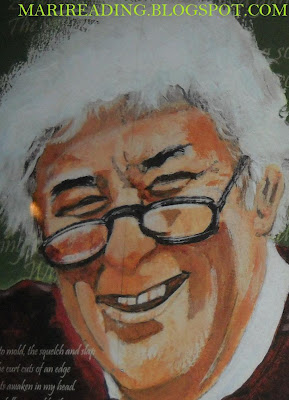
Seamus Heaney @ Temple Bar, DUBLIN.
Deane's mother is described in the novel as having “a touch of the other world about her” and also let me tell you that Deane is another marvelous feminist. In the chapter that gives name to the novel, “Reading in the Dark”(19), the narrator reveals that the first novel he ever read was a book from her mother called “The Shan Van Vocht, a phonetic rendering of an Irish phrase meaning The Poor Old Woman, a traditional name for Ireland” (D:19). As you can see, the comparison between Nature and Woman expands and we have a triangle thanks to the Ireland implication; traditionally, all the greatest poets have developed the image of Ireland as a woman. Even Seamus Heaney keeps drawing on this tradition, in his poem“Act of Union”, describing this union with Great Britain as a forced marriage, etc. I love the implications that Deane arouses here, listen: in her mother's book, the son finds his mother's maiden name handwritten there. His reaction is the following: "They seemed strange to me, as though they represented someone she was before she was the mother I knew" (D:19). This intense triangle awakens all the more interesting ideas in my head, like the notion that probably Deane's mother can be read/works as a symbol of Ireland.The exploitation and violation of Ireland by the British governments and forces as the ill-treating of woman by the patriarchal society expected of officially Catholic Ireland. The Emerald Isle, Éire, the virgin green soil, Mother Ireland, Mother Earth, Goddess Earth. The Poor Old Woman, after the forced marriage with the British tyrant (“And I am still imperially / Male, leaving you with pain” S. Heaney). Deane's mother's maiden name, pre-society. See? An Irish woman of her times was a double victim: of Irish history, and of British too. A sublime novel never wears out. It never wears you out either. Never exhausted, always new things to learn and explore! To sum this paragraph up, Deane and Barry are amazing feminists, to achieve that they turn to Nature. Out of civilization. Out of religion. Out of politics. 

Reflections: Garden of Remembrance, DUBLIN.
To end this list of features that Deane's Reading in the Dark and Barry's The Secret Scripture share, let me add a shallow one: the front covers of my copies. They are the ones in the picture I posted in the previous post. Misty mysterious emotions were aroused when I first laid my hands on them. Reading in the Dark: the old worn-out picture in a broken-glass frame speaks directly to you. About broken families? About conflicted childhoods? Cracking Ireland? If the first time you see the cover you know that Seamus Deane is from Derry and was a direct witness of The Troubles, the image of the broken glass will awaken even more implications. As if all that shallow beauty wasn't enough, on the back-cover we have some lines by Seamus Heaney himself, another Derry-man. According to him, the novel is “(...)a swift, masterful transformation of family griefs and political violence into something at once rhapsodic and heartbreaking”. These lines confirm your initial suspicions as regards your novel expectations based on the book´s outward design. Nevertheless, you could never do justice to this novel in words, not even a Nobel Prize like Mr Heaney himself :) You've got to feel it. As regards the cover of The Secret Scripture, since I hate repeating myself, I will kindly redirect you towards a previous post in which you can read me talk about its overwhelming beauty.

Union Jacks clouding the Irish sky... (BELFAST, Sept 2011)

Having reviewed all the points in common, it is time to draw the portrait of each author individually. I have to confess that despite the long list of similarities, their profiles as Irish authors of fiction could not be more disparate. Despite the generalizations I have previously discussed, and the labels I have created to draw Deane and Barry together, each of them is unique in his own way. With such charismatic similarities, the differences, as you can imagine, are abysmal. Deane, as the dedicated literary critic he is, gives top priority to form. For Barry, as the crafty creator of delicate, stimulating and often problematic narratives that he is, plot takes precedence. Unfortunately, I think The Secret Scripture, as far as formalistic devices is concerned, is not very original, nor successful. Maybe if I had read it in isolation, without having read Deane's novel first, I would have not paid much attention to this aspect, as usual. To tell you the truth, I'm more of a lover of content than of form! Nevertheless, I have to excuse Mr Barry for that :) Maybe I am getting biased towards him since he is haunting me since Dublin, you know :) but a tale of the proportions of The Secret Scripture is difficult to contain in a kind of narrative other than the diary form. I think the author took his time and dedication to decide why this form and not another. I suspect Barry must have thought that the content had such an intense life of its own that if he paid too much attention to form originality, the content might lose gorgeous weight or, eventually, crumble. In sum, Roseanne had to speak to the reader directly:
“Dear reader! Dear reader, if you are gentle and good, I wish I could clasp your hand. I wish – all manner of impossible things. Although I do not have you, I have other things. There are moments when I am pierced through by an inexplicable joy, as if, in having nothing, I have the world” (B 24)

DALKEY, Dublin.
Imagine The Secret Scripture in a Reading in the Dark form. Very risky. Besides, we have to bear in mind that, arguably, Barry's goal was to re-write Roseanne:
"We were driving through Sligo, and my mother pointed out a hut and told me that was where my great uncle's first wife had lived before being put into a lunatic asylum by the family. She knew nothing more, except that she was beautiful. I once heard my grandfather say that she was no good. That's what survives and the rumours of her beauty. She was nameless, fateless, unknown. I felt I was almost duty-bound as a novelist to reclaim her and, indeed, remake her." (Interview: The Guardian)
Ballintoy, Northern Ireland.
I love this explanation. Barry's project is to set Roseanne's micro-narrative against the backdrop of the Irish metanarrative of the 1920s and 1930s. The structure of his novel reminded me of Bram Stoker's Dracula. It is very similar, same style: juxtaposation of diaries. Obviously the final product tastes a bit artificial. I would say that in Dracula it gets more real, it is more reasonable. Nonetheless you cannot escape from that synthetic flavour. But in The Secret Scripture, the form lacks freshness, it is too traditional. In any case, the author must have chosen the journal form to present Roseanne's story without filters. Besides, it was the only way of presenting the conclusion of the story, when all ends meet. A bit Dickensian, isn't it? But life is like that, I bear witness!

Approaching Seamus Deane's Reading in the Dark formalistically, I have to take my hat off, to solemnly bow, to kneel down before him. It is fresh. So minimalistic but meaningful. So straightforward. Every chapter takes the name of a word or a phrase that condensates its mood or theme. Some of the chapters are so short... I suspect that's a sweet little trick from Deane to get us totally hooked on the novel. As a matter of fact, it is necessary that he irremediably creates the atmosphere for our textual desire on him... his novel is full of gaps –remember those gaps we discussed in a previous post? The novel works by insinuations, impressions, hunches, impulses, suspicions, premonitions... the non-spoken rather than what it is actually said. It is no coincidence that the novel opens with the following sentence:
“On the stairs, there was a clear, plain silence.” (D:5)
Bloody Sunday Memorial, DERRY.
Because of that, it is important to be constant in your reading. It is a very short novel with very short chapters. It is better to read it in a week. So you can remember all the little details of the beginning at the end. Also, because there is a lot of guesswork expected from the reader. But everything is very well summarized at the end, just in case. I have the feeling that Mr Deane is more of a reader than of a writer and that's why he took so much dedication to dream up that particular form for his novel, for the story of his life. The short titles and chapters also allow him to jump forward and skip years. We all have years in which nothing really happens. That's realism. The novel's peculiar form is a triumph because you do not notice the span of months or years in between chapter and chapter as something detrimental to the reading, to its understanding. On the contrary, it gives dynamism, it keeps it flowing, despite of the gaps in years. To tell the truth, the structure of the novel is very simple, but a supreme victory. Also, his supreme gift for words melts you. Again, very simple style but able to take you just anywhere. In spite of all the violence, family secrets and other dramas, our narrator filters the reality with dreamy eyes. The mentions and descriptions of the Grianan are remarkably beautiful for instance. Reading in the Dark is an excellent novel: the victorious form is accompanied by a beautiful-but-sad plot that makes you close the book with a deep sigh, yearning for more. (Then it is when you decided to initiate The Secret Scripture and you have not stopped sighing ever since :)) Before the end, just let me add: more points in common, although weaker, see “rats” and the bombing of Belfast during WWII.

Garden of Remembrance, DUBLIN.
This post is an adaptation of an e-mail I once wrote for the lovely person who gave me these two books as Christmas gifts. I have let it flow, so, obviously, the thing has overflown again, which means there will be more Deane and Barry posts –this time, separately– but maybe in the coming months, not next week or the following. Wow, it it unbelievable that despite the length of this post I got the feeling I have talked about each novel quite superficially. See, that is why I admire Deane so much, he has the divine quality of saying so much in so little space. So poetic (note to myself: check out his poetry!).This blog is not just about literature. But I admit that is the subject I write best about. So it is time to practice and develop other fields! As a matter of fact, even if this is a literary post, it talks about life, as you have seen. Life is literature; literature is life.
“The world begins anew with every birth, my father used to say. He forgot to say, with every death, it ends.”
 (Opening lines from Sebastian Barry's The Secret Scripture)

THANKS FOR READING ♥


-----------------------------------------------------------------------------------------------------
BIBLIOGRAPHY
  • BARRY, Sebastian. The Secret Scripture. London: Faber and Faber Limited, 2009
  • DEANE, Seamus. Reading in the Dark. London: Vintage UK, Random House, 1997.
-----------------------------------------------------------------------------------------------------

Tuesday, May 1, 2012

"Some moments stay with you for a lifetime"

Phoenix Park.
As I said in the previous post, I was already planning my April visit to Ireland in November or so. Hence, I received a thick lovely package of Irish novels as a Christmas gift. Half of them were well-known classics. When I opened the parcels and saw the covers, I could easily recognize the names, the faces, even predict the themes. But two of them were a real mystery to me! They were contemporary, needless to say. OK, at this point I have to confess I am – or have been – more of a reader of classics than of contemporary fiction. I am working to change this. It is essential to possess a well-grounded base; otherwise you cannot walk steadily on the contemporary Earth, because nothing will make sense. But if you do not pay enough attention to your surroundings, your contemporaries, you will be lost, too. But there are so many classics, and some of them so thick, and they sound so contemporary as well that I always end up caught up in a whirlwind within a labyrinth of melancholic trees from which I do not want to escape. Yeah, escapism, that's the word! But once outside the labyrinth I realise that labeling is always stupid. A book is a book.

Christmas 2011
However, I admit the first time I visited Ireland – last year – I was not able to recognize the name of any single Irish contemporary fiction author. Well, only Neil Jordan, but for his movies. That was another great discovery... Jordan the novelist! Anyway, that was very frustrating. But now that I think of it, maybe a contemporary novel can change your life more profoundly than a classic one. Its challenge is bigger. It has to both carry the weight of the past – the tradition – and provide feedback on the coexisting world, helping you find your place in the here and now. I don't know. I am just guessing. Having said that, let's mention the name of these previously mysterious men: Seamus Deane and Sebastian Barry. Okay, the first maybe 75% of a mystery – I knew him as a literary critic – but from the second one I only kept the surname when I started to read his novel. Silly me kept calling him “Stephen”. I deliberately did not want to google him, nor look at his picture, nor read his biography. You always work best when you are free. Thanks to my effort of keeping him Mr Mystery, my re-visit to Dublin some weeks ago was a bit uncanny! 

My room.
Well! The introduction took me longer than expected. And I even had to cut it down in two to add a lovely picture so that the paragraph is more reader-friendly. The reader, always the reader! After many years of academic claustrophobia, just let me announce to you that the introduction is over and that it is not necessary to include here a thesis. In a very Deane-esque style, I'll define with a word or phrase each paragraph. 

SPOILER-FREE - I have one essential rule before entering the reading process of any novel: both the back-cover or/and the introduction(s), if any, are to be read after the whole process is finished. You cannot imagine how many novels have lost part of its dazzling weight just because I accidentally read these sections first. Damn it! So, I have to say that I was so proud of myself as regards The Secret Scripture! It was just me and the text. With no intertexts whatsoever, no Barry bio, no reviews, no plot summary... no filters whatsoever. You know, the first time you pick up Ulysses, you inevitably know about Nora, about Lucia, about his exile, about his religious views. I think sometimes when dealing with authors like Joyce or Wilde you wish you knew less about their private lives. Prejudices increasing; imagination diminishing, no matter how much the author does to stimulate it. I just cannot stand critics and readers who are paranoid about finding the real-life parallelism to every single line of the novel. Having said that, if I had to choose one word to describe, not the novel, but my whole The Secret Scripture experience, I would choose *magic*. Roseanne more than once describes herself as a cailleach

Trees in Belfast.
"(…) as always not an easy task for an ancient cailleach like myself. A cailleach is the old crone of stories, the wise woman and sometimes a kind of a witch" (102) 

WH Smith, Dublin Airport.
I believe she is – she haunts me ever since. But also, her literary father does, Mr Barry. I received the book for Christmas. I chose to read it in February. In a couple of weeks. I chose to chew it slowly. Nevertheless, in April, that is, a couple of weeks ago, I realised the reading process was not finished at all. The final surprise was travelling to Dublin and find the author's name everywhere. In big, thick capital letters. Bestseller, Irish author of the month. I was so naïve, I thought that because of his unique, suave style, his nostalgic themes, he was a rather 'underground' writer, or rather an academic one, with his selected circle of readers. I am sorry, I was an irresponsible reader maybe. But as I've said before, I want to go through any book as naked as possible. But that was a happy surprise for me. How could I have forgotten, Dubliners know their literature! That was not Barcelona! Ha! Irish people read... Spaniards, do not (studies say so, not me!) After reading the novel I was so enchanted by it, I was so satisfied I needed no googling or external reviews. I knew the novel was not so new, but I did not bother to check out if he had new ones. I was already busy reading GB Shaw, if I remember correctly. 
DART to Sandycove.
But I have been googling him often since I returned to Barcelona and I am so proud of him! :) Also, I just found out that the novel I kept seeing advertised in train stations and bookshops during my trip to Dublin came out in summer 2011....And I've just guessed by looking closely at one of my pictures that the ads were for the e-book and paperback edition – the one I got, ignorant as I was of the existence of the hardcover one! :) At the beginning of this paragraph I said I realised in Dublin that The Secret Scripture process wasn't finished. And that is when a (sublime) novel marks the difference. Its reading process never finishes. Keeps coming back to you. Anytime, anywhere. Also, it reads you. The textual desire for it never ends. Makes you come back to it any day any time and read a random quote. Even re-read the whole text. Haunts you, you are so charmed by it your daily life won't look as dull anymore. The text transcends the printed word and gets tattooed on your soul. Because Roseanne exists. Maybe because she is you. Or you are hers. So, needless to say, this review has no spoilers. Maybe just some hints that will sparkle your interest in case you have not read the novel yet. But that's all. I promise! 

Connolly Station
MYSTERY - As a general rule, I believe you cannot tell a book by its cover. But with this case in particular I allowed myself to be superficial. It was love at first sight. I saw the cover of the novel and I decided that was the last book I was going to read, out of the six I received. I wanted Roseanne's evading look to speak to me during the waiting. She received a preferential place in the bookshelf of my desk. There are many editions, of course, as the bestseller it is, but the lovely person who gave me this book chose the cover carefully. As you can see here, the match of deep red with the gold letters is a most beautiful combination. Adds a certain vintage aura to the book. Then, you have that haunting picture of the profile of a mysterious woman with melancholic eyes, hair nicely tied into a bun, and a simple necklace hanging down her neck. So evocative! But of what? Textual desire working at its best! Well, maybe I lied. I said before that the reading process had involved just me and the text, no external stuff. But there was another presence there. That poignant picture. There was that woman in the cover I modelled to be young Roseanne. I am totally against covers which show a clear picture of any face. Isn't that intimidating? Unless it is a picture of the real writer, or a real, historical person the book is dealing with, of course. But in this case, the picture leaves a lot to the imagination. As I've said, it is evocative, it is suggestive of many things which although heart-breaking, we are brave enough to go through. You can tell all that much by its cover. The neck, the bun, the eyes. Enchanting simplicity. Life. Goddess Earth

EASON - I was on Connolly Station and when reaching the platform of the DARTs to Sandycove, one of my travelling companions pointed me to Roseanne! There she was at the top of a big rolling ad of Barry's latest book, On Canaan's Side. Our heroine was there to remind people of her real existence and support her creator in his new literary adventure. Lovely. Ah, sure, here I need to mention it was my Roseanne, the one with the golden letters and the bun! How awesome is that? You have to understand, we do not get that in Spain. The ads you normally see on the transportation services are of movies like Battleship or Twilight. Or best-sellers like the Millenium or Harry Potter sagas. To sum up, in Spain good literature is the antonym of best-seller and the other way around! So, I thank Irish readers for making it possible for me to be haunted by Sebastian Barry during my last visit to Dublin. Speaking of Sligo – well, actually I haven't said anything about it yet, so maybe I should mention that this is where the novel takes place. And isn't Sligo the Yeats country? 

“Swift haunts me; he is always just around the next corner” W. B Yeats 

DART to Sandycove
Well, well, Mr Barry, I can just say the same thing about you! :). OK, so the next day: same station, different direction. Connolly to Howth. Barry on every single station. Oh, dear! Can this be real? Once again, there is the profile of an enigmatic female figure looking away from us with the following description: Some moments stay with you for a lifetime. FASCINATING. Back to Dublin in the afternoon I went straight off to O'Connell Street and there Eason made the rest. I was happy :) 

IMPROVISATION - Sebastian Barry is a spellbinding author. When I saw the cover it was love at first sight. When I read the book I became Roseanne. And since back from Dublin I cannot stop thinking about him. On Canaan's Side is now in the place that once belonged to Roseanne. Waiting, looking away from me. I still do not know her name. I know Mr Barry will send me his signal when he thinks I am ready. After all, he guarded me in my last visit to Ireland :) Oh, what to do, what to do? Shall this post just be an introduction to the post I had on mind? I wanted to talk about certain aspects of the novel, and make a comparison between Seamus Deane's Reading in the Dark and Barry's The Secret Scripture. I want this blog to be dynamic and with a strong oral quality. No limits or restrictions. Roseanne is a bit like that in her diary, ain't she? :) So I have to cut it down here. Off to daily life. Oh well. 

Thursday, April 26, 2012

APRIL is the cruellest month


ABOUT - The title of this blog is because of Seamus Deane's novel of the same name. I became aware of the urgent need to launch my own personal blog at the moment I landed in Barcelona from Dublin four days ago. I started planning my second visit to Ireland around Christmas. And so, as a Christmas gift I received a thick lovely package of Irish novels – classic and contemporary – and yes, one of them was Deane's. Even before I knew of this novel I was already grasping the notion of visiting Derry. After reading the novel I was convinced the visit to Derry had to be the highlight of my Irish holidays. However, it was not so. But that's another story. And needless to say, the lovely city of Derry is not to blame. External circumstances. It deserves its own post. To be sure, to be sure! So, as I was saying, I am totally in love with Deane's novel. Also it was very, very special because the limits between the fiction and my reality became hazier and hazier each passing day. Derry is the location of the novel. Derry was going to be the location of part of my holidays. I really enjoy literary tourism!


Bogside,  Derry (April 2012)

APRIL - The title of this post is taken from the classic poem "The Waste Land" of the magnificent  T.S Eliot. Anyone who has read any poem of his, or even just a couple of verses, can easily tell, without much technical knowledge, that Eliot's work is strongly intellectual. I mean, any of his poems is a web of intertextualities, a never-ending net of cultural references - say literary, cultural, historical, etc. I mean, you have to decipher, you have to check History, you have to think, you have to research. Once you have deciphered all the hidden meanings and located all the historical references in its time and place, the poem is like a caterpillar becoming a butterfly. It's such a gratifying challenge! The butterfly image is funny. I did not plan it, it just came out! Probably I'll regret it later, but it is good because I can use it to go back to the main point of the paragraph, April (because it is a natural process and also because it's spring!). So, in spite of T.S Eliot being an indisputable synonim of intellectualism, that is,  of modernism, my most personal connection with him is irrational. The whole paragraph beginning with "April is the cruellest month" is full of intense references to... my own life! I remember the first time I read it, I thought it was a joke! It scared me... Well, another topic for its own post! Notice the "Marie", and I am Mari! Apart from the whole 'Waste Land' thing, April has other intense connections with me... many elements that define me. Like the day of the proclamation of the Spanish Republic, my birthday, and also Toshiro Mifune's! Also, the Irish Easter Rising 1916... I better stop here because I know I'm forgetting many others...!

Sandycove, Dublin (April 2012)

LANGUAGE - I am a bilingual speaker of Spanish and Catalan. However, my favorite language is English. Spanish for some reasons, and Catalan for some others, are most of the times obstacles for me to be myself. I often find myself thinking in English. After all, what can you expect? MOST of the novels I read are in English, the films also...In my opinion, the English language is more convincing, more concise, more powerful. Since I finished my degree, I don't have many chances to practice it often, so I thought that maybe starting to blog would be a nice idea. At least it would force me to search new and/or mysterious words in the dictionary... So I hope this blog is theraupetic in that way! To heal my English wounds! 

AUDIENCE - Of course, the main reason for starting this blog is personal. To practice my English, but mostly to let my thoughts flow... I'll be writing about literature mostly, but who knows. Sorry, what I wanted to say in this section is that although I started this blog to/for myself, it is always nice to be read. As a matter of a fact, one of the other reasons why I started it was as a kind of "reward" to all that people whose blogs at some point or other have helped me to chose one option or other as regards trips, novels, etc. Whether I get acknowledged or not, I would feel honoured to be of any help or advice to anyone out there. So, thanks for reading!!